
Conducting Scholarship through Personal and Collective Crises
On Survival Mode, Autoethnography, and Writing amid Fragility.

“You have power over your mind—not outside events. Realize this, and you will find strength.” - Marcus Aurelius

Dear qualitative Inquisitor,
I hope this finds you well and healthy as we end Spring and move toward the beginning of Summer.
I regret that this issue had to be delayed a few months, but I have come to believe that delay is sometimes for a reason, beyond the perfectionism or emotional value we place on our writing.
Even now, I cannot promise a perfect edition, as I had hoped, to fully give justice to this topic. But it feels like the right time to finally put this out anyway.
In the previous edition, the first of this year, I introduced autoethnography as a promising and rigorous method within qualitative inquiry and shared its relevance to my work on Pakistan. I had originally planned to continue my series on autoethnography this Spring, and I hope to continue that exploration this Summer.
Autoethnography involves personal writing, and while there are a few critiques in some disciplines against personal writing in the social sciences, it is something I have engaged in for a long time, especially through my advocacy for mental health, women’s rights, human rights, and social justice.
May is Mental Health Awareness Month. As a long-time mental health advocate, I wanted to remind people to remain open to conversations on mental health and everything that encompasses it.
This edition is about crisis, pressure, emotional struggle, and intellectual labor under strain. My reflection comes after several attempts over the past few months, which perhaps says something about the emotional difficulty of writing through crisis itself.
As I was writing this, I felt the burden of what I was trying to articulate. In many ways, the delay became part of the reflection itself. Perhaps now is exactly when this piece needed to be written and disseminated.
After a three-month hiatus from this newsletter, and at the end of another academic year and semester, I found myself reflecting on how we proceed through overwhelm, disappointment, and personal and collective struggle. Many people are suffering right now, in different ways.
I began pondering a slightly different yet deeply related question:
How can scholars continue producing knowledge during periods of personal and collective crisis?
Surely this is not new. There have always been different forms of crisis throughout history. But still, no one truly prepares you for conducting scholarship during ongoing instability, uncertainty, and setbacks.
The Qualitative Inquisition (Qi) has consistently emphasized the importance of critical reflexivity, and this moment has forced me to confront a reality rarely discussed openly in academia:
It is rarely just one moment of crisis.
So how do we continue operating through ongoing setbacks produced by overlapping crises?
The romanticized image of academic life — quiet libraries, intellectual coffee shops, stable funding, community support, camaraderie, uninterrupted research time, inclusivity — rarely exists for anyone. And for many underrepresented scholars, including myself, it can feel even more distant, even after the moment you thought you had finally overcome …or “made it through.”
Hence, in the past several years, many of us have been forced to conduct scholarship while navigating overlapping pressures and layers of disruption such as:
Global crises unfolding in real time (wars, genocides, pandemics, climate disasters)
Political polarization, geopolitical instability, and conflict
The genocide in Palestine and its global emotional and political impact
Financial precarity, economic instability, and constrained academic job markets
Structural marginalization and systemic barriers (academic bullying, micro and macroaggressions, institutional exclusion)
Gatekeeping and social/professional exclusion within informal academic networks
DEI challenges in academic and workplace spaces
Isolation, loneliness, and mental health struggles across multiple sectors, including academia
There is one certainty amid the uncertainty: these events accumulate and impact cognitive functioning. They slow trajectories and sometimes even halt progress altogether.
Yet academia, or at least many academic spaces, still resumes a culture of “business as usual,” operating as if scholars exist outside the world’s crises.
Productivity expectations remain unchanged. Publication timelines remain rigid. Hiring biases persist toward non-linear trajectories. Career structures continue to assume forms of stability that many scholars simply do not have.
For scholars from marginalized communities, the burden can become even heavier. We are expected to maintain a perfect work ethic — perfect performance of professionalism — while simultaneously absorbing both personal and collective trauma.
Building Through Crisis
These issues raise an important methodological and pedagogical question:
How does scholarship continue under conditions of survival?
At last year’s American Political Science Association Teaching and Learning Conferences, I brought forward the importance of incorporating trauma-informed approaches into research and teaching. After the Annual conference, on World Mental Health Day, I shared a reflection piece titled:
Surviving Academia, Sustaining Hope: A World Mental Health Day Reflection
I reshare that reflection again during Mental Health Awareness Month because these conversations remain urgent. While academia has, in theory, acknowledged that scholars and students are not detached observers of the world, it still struggles to operationalize what it means for us to also be participants within it.
A trauma-informed lens, one that incorporates empathy, compassion, and awareness of where students and scholars are emotionally and psychologically, is not meant to lower intellectual standards. Rather, it recognizes the conditions within which knowledge production actually occurs.
For many scholars, especially those navigating fragility, instability, marginalization, grief, or prolonged uncertainty, scholarship itself can become intertwined with survival, healing, meaning-making, and resilience. This is true within qualitative inquiry, where reflexivity, positionality, lived experience, and emotional proximity are often central to the research process itself.
In many ways, this reflection became less about productivity and more about sustainability: how we continue thinking, writing, researching, and creating when life itself always feels unsettled.
“The wound is the place where the Light enters you.” - Rumi
Nine Strategies to Build through Crisis
A work in progress is still scholarship, even when it is not meeting your self-imposed deadlines. From my own experience, several practices, observations, reflections, and habits have helped sustain my scholarship during difficult periods, including the one I am still navigating now:
1. Build intellectual support networks.
It is important to acknowledge that this is not easy for everyone. But scholarship does not have to be an isolated pursuit. Pandemic life intensified that isolation for many of us, but connection and community can always be rebuilt. Peer networks, writing groups, mentors, and informal scholarly communities can provide essential support for both students and faculty.
2. Stay connected even when under-resourced.
Even small forms of engagement — sharing ideas, writing short reflections, attending relevant events, reading consistently, or participating in conversations — can help sustain your trajectory. The key is finding practices that help maintain intellectual momentum, even during slower or more uncertain periods.
3. Recognize that productivity will fluctuate.
Sustaining intellectual momentum can sometimes come through modest, gradual installments. There are moments when we need to hit the accelerator, but consistency in reading, review, and engagement often matters just as much as intense bursts of output.
Deadlines matter, but it is not unheard-of scholars missing them for reasons beyond their control. Periods of crisis naturally disrupt research and productivity. Allowing space for slower periods does not diminish long-term scholarly contribution. It is important to allow scholarship to grow steadily, even when progress feels slower than expected. As Confucius is often paraphrased: “It does not matter how slowly you go as long as you do not stop.”
4. Integrate reflexivity into scholarship.
Qualitative researchers benefit from acknowledging how personal and collective contexts influence research questions, interpretation, positionality, and engagement. I have written previously about journaling and reflexivity in qualitative inquiry. Autoethnography can bring particular strength when studying difficult topics, fragile regions, trauma, conflict, or deeply human social issues. I hope to share more on this in future editions this year.
5. Cultivate resilience through communities of care embedded in scholarly practice.
Despite increasing scholarship on this issue, resilience in academia is still often framed as individual perseverance. But resilience can also be collective — sustained through communities that value knowledge-sharing, mentorship, solidarity, and communities of care.
For many scholars, especially during periods of precarity, crisis, isolation, or transition, simply knowing that others believe in your work and want you to continue can make an enormous difference. Sometimes resilience is not only built through personal discipline, but through encouragement, collaboration, intellectual belonging, and the reminder that we do not have to navigate scholarship entirely alone.
6. Embrace a few non-academic hobbies.
I have shared in past editions that I enjoy blogging, creative writing, painting, drawing, and have recently taken a stronger interest in Quranic calligraphy. Rekindling my relationship with painting in the middle of my PhD program eventually led me to “Painting Heals Pakistan,” which I later expanded to support awareness, advocacy, and fundraising connected to collective crises, and more recently to support educational endeavors while under resourced.
Beyond blogging and painting, both of which were nurtured during my PhD program and continued through this next chapter of my scholarly career, I also hope to return more intentionally to sports like table tennis, tennis, and soccer when life feels a little more settled again. But it is also possible that day may never come when you feel “fully settled.” Not as an academic. At least not for a long time. So, it’s important to make time for it.
7. Do not neglect your health.
Much has been written about burnout in academia, and the psychological impact of academic life continues to be a major concern. Isolation, lack of community, financial precarity, physical health, and prolonged stress all affect our ability to think, write, and function sustainably.
I am still trying to find better balance myself and recover my health during this prolonged post-PhD transition period. What I have also observed through lived experience is how difficult it becomes to complete scholarship while navigating deprivation, instability, or living paycheck to paycheck. It is still very important to pay attention to your body.
8. Do not compare your trajectory to others.
This is harder than many people are willing to admit. Comparison is a progress killer. It is a community killer. It can silently damage professional and academic relationships as well.
I have always felt strongly about resisting comparison, though like many people, I have also struggled with it at times. It requires conscious effort to refocus on our own path, growth, and purpose rather than constantly measuring ourselves against others.
9. Enjoy the process.
As many people say, it is about the journey, not only the destination. Take it in. It’s brutal at times. There are moments where you come to wonder why you chose this path at all. And then there are moments where you remember exactly why. Sometimes the process itself becomes the reward: the learning, the reflection, the conversations, the small breakthroughs, the relationships, the meaning that slowly builds over time. Even through crisis, disappointment, exhaustion, and delay, there can still be something beautiful in continuing forward anyway.
In practice, many of these reminders sound simple, but they are easy to forget when deeply immersed in scholarship and survival at the same time. Beyond coping mechanisms or productivity strategies, I have to remind myself why I started this journey in the first place. For me, it was never only about outcomes. It was also about the process of inquiry itself.
It is easy to feel like you should stop when confronted with crisis. Your trajectory may become slower than your peers or slower than what was once expected of you. But slow progress is still progress. A great deal of burnout in academia comes from the pressure to constantly accelerate. Sometimes real sustainability comes through deliberate, steady movement over time.
There are moments when everything finally feels like it is coming together, and then suddenly another disruption throws you off balance again. Momentum feels real, routines begin forming, and then something unexpected interrupts the progress you were carefully trying to rebuild.
In academia, setbacks are sometimes stigmatized even though nearly everyone experiences them in some form. But setbacks also become part of the process. Even if it feels like you are starting over repeatedly, you are not truly starting over.
Here, I want to emphasize something I have reflected on throughout this edition….
scholarship itself can become the tool or method of resilience.
Continuing to think, write, question, and analyze during difficult times is not merely professional work. It is also an affirmation that intellectual inquiry remains meaningful even when the world feels unstable and time feels merciless.
For those of us engaged in qualitative research, this may be particularly important. Our work seeks to understand human relationships, lived experiences, power structures, and complex social environments. Sometimes those environments include crisis itself.
So perhaps the question is not simply how we conduct scholarship despite crisis, but also how scholarship can help us understand and respond to it.
As one reflection point, I would be curious to hear from fellow scholars:
How have you sustained your scholarship during periods of personal or collective crisis? What would you add to the above list?
Some Personal Notes on Personal Writing
I often share personal observations even in my academic and professional writing, though I keep it filtered as much as possible within those spaces. In recent years, this has become a difficult lesson to navigate, because not everyone is prepared for a certain level of vulnerability.
Still, I have found that personal reflection can be a critical part of qualitative inquiry and can add value in understanding positionality, reflexivity, and the relationship between the researcher and the research itself, themes I will continue to explore in forthcoming Qi editions.
Studying Fragility While Living Fragility
“Lived Experience” has become something of a buzzword or catchphrase in recent years. But I do not think its importance can be overstated, particularly because it has historically been overlooked or undervalued in many academic spaces.
It is safe to say that many of us have endured crisis in one way or another. Some face harsher realities than others. Some internalize the trauma of world events more personally and deeply than others.
I study fragile states and the people inhabiting these spaces. I often reflect on how the resilience I witness while studying fragility and human perseverance has, in turn, helped me remain resilient in my own academic and professional goals.
I must admit that I do not think I would be a strong fragile states scholar if I simply gave up on my own scholarship during difficult periods.
I try to understand not only political systems or institutional structures, but also the people within them and the realities they navigate, maintaining a people-centered lens throughout my work. Scholars with lived experience of fragility often perceive dimensions of fragile contexts that others may overlook, misunderstand, or even flatten.
People who have personally navigated instability, precarity, displacement, marginalization, conflict, authoritarianism, or social fragility can develop heightened sensitivity to power, relational awareness, emotional intelligence around survival systems, and skepticism toward overly neat institutional narratives.
Lived experience can offer forms of insight, reflexivity, relational understanding, and ethical sensitivity that are valuable in studying fragile contexts. At the same time, suffering alone does not automatically produce expertise. However, lived experience can sharpen our awareness of instability, power, survival, and the human dimensions obscured within institutional analysis.
Having a trauma-informed lens is especially important for students, scholars, and practitioners studying or teaching fragile and conflict-affected states, where repeated engagement with literature documenting abuses, atrocities, violence, and displacement can itself lead to secondary traumatization if we are not careful.
Perspective through Faith
Not only is this Mental Health Awareness Month, but we have also entered the month of Dhul Hijjah in the Islamic Calendar, year 1447.
And on the very first day of Dhul Hijjah, we received devastating news. Three brothers in Islam, Amin Abdullah, Mansour Kaziha, and Nader Awad, were martyred in a brutal hate crime at one of the largest Islamic Centers in San Diego, California. This happened two days after we commemorated the 78th Anniversary of the Nakba.
These are not easy times for Muslims. In many ways, Muslims around the world continue navigating grief, dehumanization, violence, displacement, Islamophobia, and the emotional burden of witnessing suffering unfold globally in real time. Yet amid that reality, many still continue trying to hold onto faith, community, compassion, and hope.
Earlier this year, I was advised by a Political Science professor from another institution to remove my hijab for the academic job market, to take it off for interviews, as if creating distance from my faith would somehow increase my chances of employment in academia. I was deeply hurt by that, as I only recently transitioned back to Hijab, as a permanent shift. But given the political climate, I can’t pretend it hasn’t been difficult. I will share, in more detail, about the experience navigating the market in a future edition.
I started writing this newsletter edition during Ramadan, and intended this to be a companion reflection to share alongside this particular Medium article at that time: “Embracing Ramadan through Personal and Collective Crisis.”
I wrote about experiencing Ramadan during periods of personal and collective hardship, and some of the challenges I have faced over the past few Ramadans, being a time of deep reflection for many Muslims around the world. I remain on the academic market this cycle, continuing to apply for opportunities as they emerge. I am also continuing to polish manuscripts and move my publications forward. That companion reflection focuses more specifically on the spiritual dimension of navigating these challenges.
I recently learned that the first university is widely believed to have been founded by a Muslim woman: Fatima al-Fihri, who established the University of al-Qarawiyyin in Fez, Morocco in the 9th century. Learning this during this chapter of my academic journey feels special and symbolic for me, especially in my ongoing transition as a Muslim hijabi woman continuing to navigate academia, scholarship, belonging, and faith through periods of uncertainty and crisis.
At a time when I was being advised by someone in academia to distance myself from visible expressions of my faith for the job market, I cannot forget that Muslim women have always had a place within intellectual history, knowledge production, and scholarly tradition.
And as I’ve been using faith to heal from the traumas of personal and collective crisis, I am reminded that faith and scholarship do not have to exist in opposition to one another or without one another.
I am continuing to make efforts, in the best ways I can, to emerge from many of these challenges, and faith has helped me tremendously in doing so. I have noticed that in many secular and liberal spaces, speaking openly about faith is less common. This is not meant to impose anything on anyone. It is simply to acknowledge that we all have different ways of healing, grounding ourselves, and making meaning through difficult periods of life.
Over the past few years, and especially after my travels to Mecca this past year, I found myself reconnecting more deeply with my faith in ways that have brought healing, perspective, and resilience during difficult periods. I also deeply appreciate those who have supported me throughout this transition, and I hope we can continue bringing more openness, empathy, and understanding to these conversations going forward.
Choosing Not to Perish - Resilience and Momentum
One of the things I have learned through this newsletter, alongside my broader blog writing over the years, is that continuing to write through difficult periods can help nurture resilience.
A 10 Year Anniversary
It has now been over 10 years since I first mustered up the courage to begin blogging. Recently, I wrote a reflection piece on my personal blog marking that milestone. Over the past decade, blogging through Wordpress and, at times, through social media helped me cope with — though not necessarily defeat — the imposter syndrome that still persists, including the same fears and doubts that can delay submissions and make scholars question their own voices.
As I shared in my reflection piece on Medium and on my personal blog, those writing spaces became places where I processed uncertainty, built confidence, and continued finding my voice in both creative writing and academic scholarship.
I also reflected on my academic journey and the importance of staying resilient, not being ashamed of asking for help, and supporting others when they need encouragement themselves.
Inaugural Social Capital Conference Participation
Recently, I had the opportunity to present research connected to my doctoral studies on USAID at the inaugural Social Capital 2026 Conference.
I later wrote a short reflection on that experience titled Tying the Camel: Reflections from Social Capital 2026. Even though the conference ultimately had to move online, it still felt like a landmark event it intended to be for the global social capital community.
One valuable outcome from that experience was the possibility of future collaborations and invited book chapter contributions, which I hope to share more about in the coming months and years. After conducting scholarship through prolonged precarity, uncertainty, and personal crisis, moments like these remind me that intellectual work can still continue moving forward even during fragmented seasons of life.
Conference Participation Continues
Earlier this year, I was grateful to learn that two of my papers were accepted for presentation at the 2026 Annual Meeting of the American Political Science Association (APSA) in Boston this September. The news arrived during the final ten days of Ramadan. After several years of pursuing my research independently, it has felt encouraging to see my work continue finding space within ongoing scholarly conversations especially at a major institution in my field.
My paper, first presented at an earlier stage of development during Social Capital 2026, will be shared on a full paper panel titled Aid under Stress: Retrenchment, Crisis, and Strategic Reallocation in the International Political Economy Division.
A second paper, Taking It to the Streets: Decolonial Solidarity for Indigenous Liberation, was accepted for a virtual panel titled Indigenous Politics: Kinship, Materiality, and Revolutionary Organizing in the Foundations of Political Theory Division. Due to participation limits, I will not be able to present that paper. Still, having it accepted felt deeply affirming, particularly given this year’s APSA theme, my research on the Global Palestinian Solidarity Movement, and the ways the genocide in Palestine has impacted not only those directly harmed, but also the emotional and intellectual trajectories of so many people around the world, myself included.
In the midst of writing this edition, I also received acceptance notifications for presentations at this year’s APSA Political Networks Conference, taking place internationally for the first time at the University of Manchester.
I remain deeply grateful to the scholars who reviewed and organized these panels, and I look forward to potentially contributing to these conversations in Manchester and in Boston this fall.
A Final Update: Awarded APSA’s Centennial Grant
While attending a Center for Global Development event on planned relocation for internally displaced persons (IDPs), I opened my email and saw it sitting in between two academic job rejections: a decision on a research grant that could help me continue building.
I had been selected as a Spring Centennial Grant recipient through the American Political Science Association Centennial Center.
A sign that I still belong in this world.
In the past week, I think my nervous system has been catching up to the reality of finally receiving some external scholarly validation for this research after such a long stretch of uncertainty.
For me, this represented much more than a small research grant or external validation. It became my first external research grant support since completing my PhD, and an important reminder that my research, writing, and long-term book projects still have a place and future moving forward.
What was even more special about this news was that I completed the proposal during Ramadan and submitted it during the final ten days with concentrated efforts on prayer and reflection. I reflected deeply on whether I still had the strength, capacity, and direction to continue this work.
Those final ten days also marked one year since I completed the pilgrimage for the first time. Receiving that news during such a reflective and uncertain season has given me a renewed sense of hope, and has made my faith stronger, as a very specific prayer was answered.
Lessons through Struggle: Support and Believe in People
I share the above because it always helps to see the rewards of our persistent efforts, however small they may be. If there are any lessons I continue taking from my own struggles, one of them is the importance of supporting one another as a community. And I remain deeply grateful to everyone who has supported me, encouraged me, collaborated with me, or simply believed in me during difficult periods.
As I continue this work, I am still sustaining much of my research through a community-supported model while continuing to search for more formal opportunities. For anyone who wishes to support this ongoing work, I have chosen to keep my 2025 fundraiser active as a gentle bridge during this transition period.
Please find it HERE. Thank you for your support!
In previous Medium reflections and within the fundraiser story itself, I share more about the broader purpose behind supporting this scholarship, advocacy, and long-term academic journey.
I recently came across a Persian proverb that felt particularly timely:
“When a tree falls, everyone hears the sound. But when a tree grows, no one hears it.”
It served as another great reflection prompt for me. Sometimes people may remember when we fall, even if through crisis (personal or external), but not when we are growing through it. Even when the growth is loud.
But much of our growth is silent, and as noted earlier, we cannot underestimate the value of our growth through personal and collective crisis. We may not see it now, but years or decades from now, we will have immense gratitude for having the strength to pull through.
Mother’s Day
It was Mother’s Day earlier this month (May 10th), and it was another day I tried to send off this newsletter. I felt the resistance again, much like I still do even now.
Even though a few weeks have passed, Mother’s Day remains one of my favorite holidays. This was the first year I did not post about it on social media. I have been slowly stepping away from those spaces. Last year, I shared an article on Mother’s Day that I wanted to reshare again this year.
There have been several pending posts from the Mini-Fieldnote series, which, like many of my pending writing projects, simply need the physical and emotional energy to complete and submit.
For now, here was the Mother’s Day special I shared last year:
This year also felt especially significant because it has now been almost a year since I last saw my mother. I look forward to seeing her in just a few days for the Eid al-Adha holiday in Wisconsin, inshaAllah.
I remain deeply grateful for everything my mother has done for me, especially throughout periods of great personal crisis over the past several years. I will always appreciate her support through recent conferences and academic opportunities. For example, during the last PolNet conference in Boston, my mother funded most of that trip herself through her own savings. More broadly, my family has continued supporting me through difficult periods in ways that many people unfortunately do not experience.
It is difficult to fully explain how meaningful family support can become during periods of instability, uncertainty, and prolonged transition. It has now been two years since I returned to my childhood hometown, and nearly a year since I last saw my mother, so I look forward to the opportunity to continue healing, reconnecting, and recovering as this difficult journey continues.
I think one of the hardest parts of this path, while continuing scholarship and trying to remain connected to intellectual work, has been the level of sacrifice involved. It is not only the financial precarity, the inability to travel at times, or the distance from loved ones. It is also the cognitive and emotional overload that scholarship can create, particularly when you cannot fully separate yourself from your research, the world you study, or the crises unfolding around you.
I knew that pursuing scholarship and public service work in Washington, DC, far away from family, would involve sacrifice. What I did not fully anticipate were the many layers of that sacrifice, especially during prolonged periods of personal and collective crisis.
Moving Forward: Thank you for Joining Qi Community
The publish or perish concept is actually very real, especially for the writer and scholar. In many ways, this newsletter’s release becomes an honest artifact of this moment.
It reflects an imperfect release during crisis and serves as a reminder that we can still produce through personal and collective suffering. We can still create impactful, meaningful, rigorous, insightful, and original contributions to our fields. We can continue giving life to our scholarship through consistency, truthfulness, implementation, endurance, and steady progress on a non-linear path.
But I hope you know that I have not perished.
I am still here, continuing to find ways to serve through my passion for writing, both academic and creative. I missed a few issues for many reasons, but I remain committed to building Qi and excited to continue writing about qualitative inquiry within the social and political sciences and beyond.
I have appreciated this journey thus far, and once again, I thank you for joining this community. I look forward to hearing your thoughts on how I can continue improving my writing and work going forward.
I hope this edition resonated in some way through your own challenges, even if only as a reminder that your struggles, story, and resilience matter too.
In my last few editions, I shared the exciting milestone of reaching 100 subscribers across my two newsletters.
More recently, I officially reached 100 subscribers for just The Qualitative Inquisition, and I sincerely thank you for being here with me. I am grateful that I have been able to continue cultivating my passion for qualitative methods during a difficult chapter of my life and through a transition I know will continue unfolding in the coming years.
I started Qi a little over two years ago. Since my last edition was in January, I also never had the chance to properly acknowledge 10 years of blogging, as I shared earlier, which is a journey connected to the eventual creation of this newsletter, alongside Sword Dispatch.
In the coming editions, I hope to explore autoethnography and personal writing more deeply, with some support from a recent book I picked up (see Recommendations below).
Alongside that, I still have remaining editions from my Mini-Fieldnote Series on the KSA, which I hope will naturally segue into broader reflections on fieldwork methods. Amid all of this, I also hope to continue discussing the importance of trauma-informed lenses in research and pedagogy, while exploring arts-based research methods more intentionally.
There are times when writers need periods of pause, reflection, healing, or distance from public writing, especially during crisis.
I think that is important and human. Still, I do want to find a way to make it up to my subscribers. In the meantime, I will certainly make a stronger effort to maintain the monthly newsletter, even if an edition is brief.
It is important to also remember that even if your work is only for yourself, even if people drift away from your space during periods of crisis, healing, or rebuilding, sometimes we write simply to prove to ourselves that we could still do it.
And I am glad I can submit this proof for myself.
This was admittedly a very difficult edition to write. And after finally finishing it, I can understand why.
Perhaps part of the reason this edition became so difficult to finish was because it stopped feeling like “just” a newsletter. Somewhere along the way, it became a reflective essay, a methodological reflection, a public intellectual meditation, and a semi-autoethnographic piece all at once.
For a long time, I interpreted the recent pause in The Qualitative Inquisition as a sort of disappearance, as though the gap between editions somehow invalidated the platform, the work, or even the intellectual identity behind it. But I am beginning to realize that returning matters too. The platform still exists. The research trajectory still exists. I am still doing the work, even through periods of exhaustion, delay, uncertainty, and rebuilding.
And even if it is imperfect or too long, or even “incomplete” in some ways, I still feel a sense of accomplishment with this edition arriving at the end of the academic year and entering the summer season. The past academic year began with a paper I completed on challenging mental health stigma, presented at APSA, and I am grateful that I can now share this reflection with you as well in Mental Health Awareness month, and during the first 10 days of Dhul Hijjah.
I have learned how truly unbearable it can feel to hold onto unfinished drafts as writers and scholars, and I hope to continue finding the courage to eventually press “publish,” “post,” or “submit,” even through uncertainty, fear, perfectionism, imposter syndrome, or exhaustion.
I want to express gratitude to everyone who has supported my personal and professional development and who has been part of my journey thus far. I especially appreciate those who continue engaging thoughtfully and compassionately, even across differences.
I hope we continue to stay connected, empowered, and resilient.
And I hope to see you again in the next edition!
In Solidarity & Peace,
Dr. Elsa
TOP 7 First Quarter 2026 Highlights
This year’s theme for Mental Health Awareness is “More Good Days, Together.” Mental Health America founded May as Mental Health Awareness Month in 1949, as an opportunity to spread awareness about mental health. I remain passionate about advocacy for mental health. I hope to share more reflections on mental health in future editions.
May Day (May 1st) is reserved for honoring workers around the world.
And much respect to those who died in service to our country, on Memorial Day. a day that also marks the “unofficial beginning” of the summer!
I just wanted to share a happy belated International Women’s Day (March 8th) and Women’s History Month! (March). I hate to miss any opportunity to reflect on female empowerment. But similar to Mother’s Day, as the saying goes, every day is women’s day. A reminder to reflect on our struggles and achievements throughout the year.
Also, this was my Feb 1st “World Hijab Day” Reflection before Ramadan. It was the first World Hijab Day reflection so I wanted to be sure to share that. (I aim to try to share a longer essay/blog post on my Hijab story later this summer or fall.)
*******
TOP NEWS ROUNDUP:
What I’m Reading…
Ten Humanitarian Crises that Demand Your Attention Now
Rethinking Humanitarianism | Diaspora aid: the lifeline we don’t talk about enough
A Blueprint to Transform Humanitarian Aid
78 Years Since the Nakba | Institute for Palestine Studies
Iran war day 86: Trump announces potential deal amid ‘cloud of mistrust’ | News | Al Jazeera
Iran Monitor | Real-Time OSINT Dashboard for Iran
Pakistan's Rising Role: Key Mediator in US-Iran Conflict Amid Diplomatic Push
How Pakistan Became the Iran War’s Unlikely Peace Negotiator | Council on Foreign Relations
Israel attacks Lebanon | Israel attacks Lebanon | Today's latest from Al Jazeera
Israeli strikes hit south Lebanon, West Bekaa — Naharnet
Sudan Genocide Continues as World’s Worst Humanitarian Crisis
Armed drones leading cause of civilian death in Sudan war: UN rights chief | UN
Taliban ‘legitimising child marriage’ with new law, activists warn | Child marriage | The Guardian
Taliban Recognises Child Marriages Valid | 'Virgin Girl's Silence Counts as Consent'
How WFP Is Helping Afghanistan Stand Strong Against Climate Shocks | United Nations in Afghanistan
Health and Well-Being:
Brain-Cleaning Effect of Walking Is More Literal Than You Think
I enjoy reading about brain health and self-care, so I hope to share more on this in future editions. Happy Mental Health Awareness Month. Do try to take time out daily to write in your journal and go for a pleasant, calming walk.
*******
BOOK RECOMMENDATIONS
The Barakah Effect: More with Less, by Mohammed A Faris
I highly recommend this book, especially to my Muslim readers and other people of faith. I listened to this during Ramadan, and now again during Dhul Hijjah, and it truly felt like the kind of book I needed during this particular chapter of my life. The book reflects on the Islamic concept of barakah, contrasting “barakah culture” with “hustle culture,” and explores how Muslims can approach productivity, time, energy, and purpose through a more faith-centered lens. It was particularly grounding for me during a period of burnout, uncertainty, and transition.
Anti-Fragile, Things That Gain from Disorder, Nassim Nicholas Taleh
Resharing this book, as I return to it myself. There is so much we can gain from disorder at micro and macro levels of our lives. In this book, Taleb introduces the concept of “antifragility,” the idea that some people, systems, and institutions do not merely survive stress, uncertainty, volatility, or disruption, but can actually grow stronger through it. The book challenges conventional ideas about stability, risk, resilience, and adaptation, themes that strongly connect to many of the reflections throughout this edition.
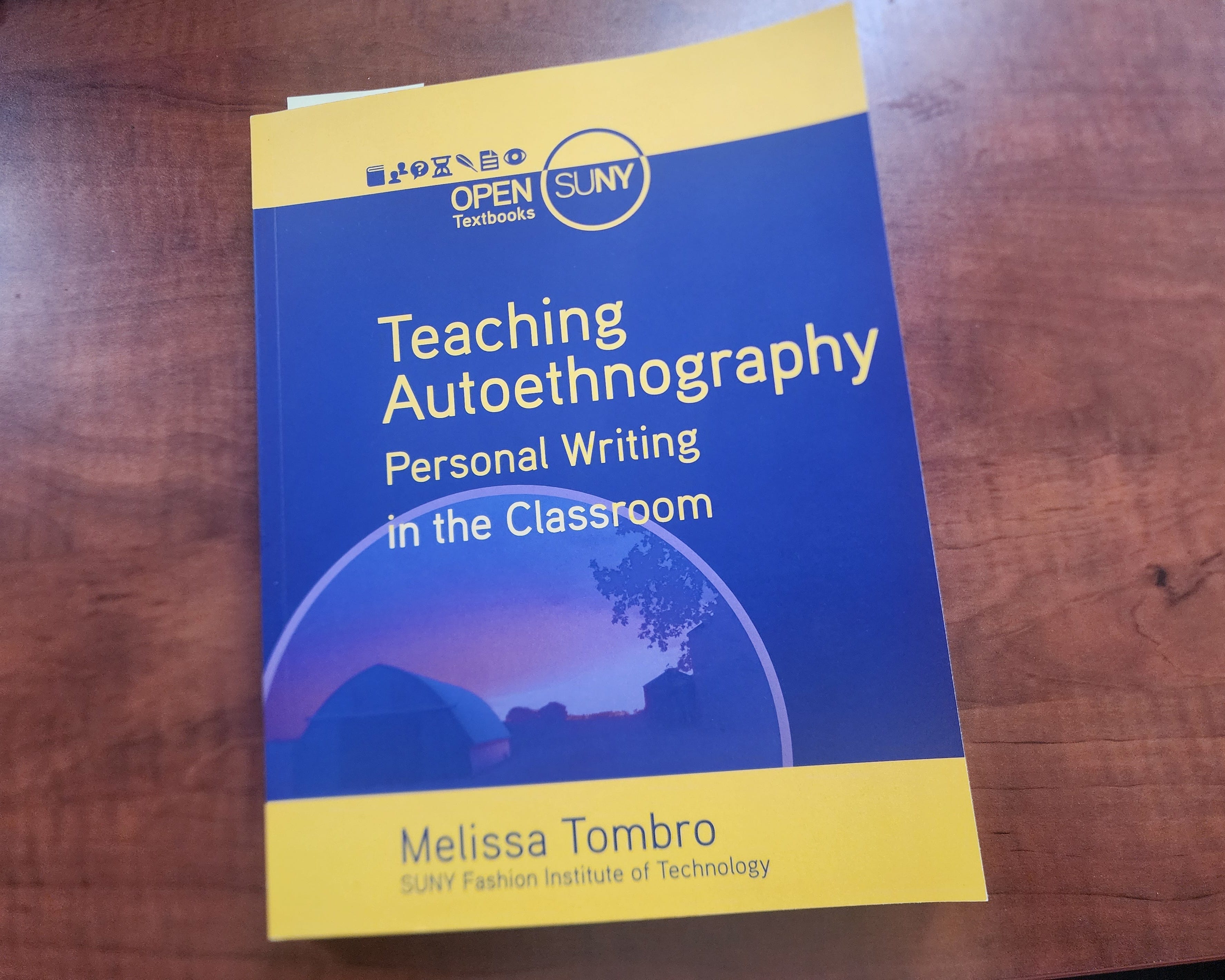
Teaching Autoethnography: Personal Writing in the Classroom, by Melissa Tombro, SUNY Fashion Institute of Technology
As shared in the previous edition, this resource has been especially helpful for Qi, my Qualitative Methods course and materials, and other courses where I hope to incorporate foundational concepts of qualitative inquiry, including reflexivity and positionality. This book explores the power of personal writing and how it can be incorporated into first-year writing classrooms or adapted into reflective and narrative-based exercises. The author demonstrates how autoethnographic and personal writing can help students connect lived experience to broader social and cultural realities while encouraging deeper reflexivity, voice, and self-awareness in the classroom.
Personal and memoir writing have always come naturally to me, and I’m glad I can find ways not only to practice it within qualitative inquiry, but also to integrate it into my pedagogy and teaching philosophy. Anyone teaching writing or qualitative methods, particularly those interested in reflexive scholarship, storytelling, and the use of personal experience as analytic material rather than simple self-expression, would find value in this resource.
*******
QUOTE OF THE MONTH
“There is no greater agony than bearing an untold story inside you.”
- Dr. Maya Angelou
Thank you for reading and engaging!
You can learn more about all my work HERE.
Feel free to subscribe to my academic newsletter, The Qualitative Inquisition (Qi), for insights on all things qualitative in the social sciences.
You can also subscribe to my creative atomic newsletter, Sword Dispatch: The WkQ Letters, for seasonal/quarterly insights on intersectionality, mental health, identity and social justice issues.
Please feel free to learn about and support my community-powered educational campaign: HERE. More on this in the forthcoming issues!
You can purchase my paintings for the campaign HERE.
If you find value in my writing and want to support independent scholars, writers, and artists, you can do so HERE.
Your support helps me continue writing, reflecting, painting, and resisting!
Thank you, I wish you well on your academic, writing, and artistic journey!
Thank you for putting this out, in the form it eventually took. The piece reads as something that became more than a newsletter edition as it went, and that's part of what makes it valuable to read.
The observation that stayed with me was the one about academia continuing to assume forms of stability that many scholars simply don't have. The doctoral discourse most researchers encounter is largely written for an assumed reader who has a kind of stability and continuity many real scholars have never had access to and were never going to have. Your point about resilience needing to be collective rather than only personal feels like the most important move in the essay — the work of staying with scholarship through difficulty is real, and it's genuinely harder when the structures around it assume conditions that don't exist.
The one observation I'd add, from the audience I think about most — part-time doctoral researchers carrying serious intellectual work alongside full professional and family lives — is that the most sustaining thing is often not a strategy at all. It's the recognition that the slow, interrupted, partial version of scholarship they're actually doing is still scholarship. That doesn't solve the structural problems you describe, but it can change what continuing feels like.
Congratulations on the Centennial Grant. That's a real thing, and the fact that it arrived between two rejections doesn't diminish it — if anything, the timing makes it more itself.